skip to main |
skip to sidebar
Topeka, Kansas
1883
 Ephemera often contains unwitting historical evidence. A case in point is provided by a small menu from the Copeland Hotel in Topeka, Kansas in 1883, the same year Emma Lazarus captured the welcoming spirit of America in her famous poem that included the line: “Give me your tired, your poor / Your huddled masses yearning to breathe free...” Although a dish on the menu alludes to this ideal, the railroad timetable on the back reveals the harsh realities of a time when masses of dispossessed people were migrating throughout the United States.
Beverly Hills,
1948
 |
| Sitting Pretty (1948) |
With his attitude of thinly-veiled disdain, actor Clifton Webb was “a blast of asexual sophistication during Hollywood’s testosterone-fueled postwar epoch,” according to Turner Classics. It could also be said that he was an integral part of the social scene. Although Webb was often cast as a family man, he lived in Beverley Hills with his mother Maybelle, an uninhibited Auntie-Mame type. Together, they threw some of Tinseltown’s most memorable parties. One such affair was held on July 1, 1948, a few months after the release of the film Sitting Pretty, a comedy for which Webb would receive his second Oscar nomination. Although the guest list is a “Who’s Who” of the movie industry at the apex of its golden age, there is one important name that is missing.
Boston
Few menus from the early 1840s have survived. Dating to a time when people seldom ate outside the home, they were rarely seen even then. Hotels and restaurants were in their infancy, slowly emerging as an expression of American ideals of mobility, democracy, and civil society. This is evidenced by two menus from Boston in the summer of 1842, showing a certain degree of uniformity in the foods consumed by the middle- and working-classes of the Jacksonian Era.
Gettysburg,
1888
 This week marks the 150th anniversary of the Battle of Gettysburg. Often described as the turning point of the Civil War, it was there that Union forces halted the Confederate invasion of the North in 1863. The ferocious three-day fight produced the largest number of casualties of any battle in the war—over 46,000 men were killed, wounded, or missing.
1859
Launched in 1852, the steamship Black Warrior was christened after the legendary Indian chief Tuscaloosa whose name comprised two Choctaw words—tusca (warrior) and lusa (black). Two years later, during one of its routine trips between New Orleans, Havana and New York, the 225-foot ship was seized by Cuban customs officials claiming that its load of Alabama cotton should have been declared, even though it was not to be unloaded on the island. The incident caused a furor, effectively derailing President Franklin Pierce’s plan to buy Cuba. Instead, pro-slavery forces demanded war with Spain, seeing this as an opportunity to turn Cuba into a slave territory. As the United States grew increasingly bellicose, Spain backed down and paid compensation for having detained the vessel whose fate would presage the Civil War.
Flint, Michigan
1882-1887
The American custom of having afternoon tea is often traced back to the late nineteenth century when the upper classes in New York began adopting their version of the British ritual. However, long before this, average women were using the term “five o’clock tea” to describe some of their get-togethers. This is evidenced by a surprising discovery of nine enigmatic menus from the mid-1880s—a rare find, as menus were seldom printed for meals in private homes.1 These mementos were apparently saved by a woman who belonged to a small circle of friends. Although the menus contained the names of the participants, the use of nicknames and initials made it difficult to determine where the social events had taken place. Nevertheless, through trial and error, it was eventually determined that the women lived in Flint, Michigan, then a town of about 9,000 people. The menus offer a glimpse into the everyday social life of middle-class Midwesterners, with one in particular highlighting the entrepreneurial spirit that would soon drive the nation forward.
San Francisco,
1923
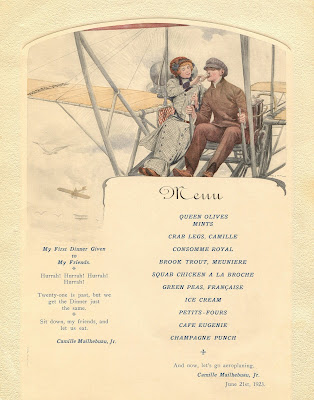
When menus are printed for a small get-together, they often reflect the underlying values of an individual or group, such as this charming menu from a dinner in June 1923 hosted by Camille Mailhebuau, Jr., eldest son of the famed restaurateur. His father had recently returned to San Francisco, opening his eponymous eatery on Pine Street, shown in the previous essay “A Moment in Time.” Although Camille Jr. describes this event as the “first dinner given to my friends,” as if he were marking a rite of passage in his epicurean family, the party was probably organized by his parents to celebrate his twenty-first birthday. It appears that his father planned this bill of fare and arranged to have the menus printed; the illustration is surprisingly old-fashioned for a youthful gathering during the Jazz Age. The image suggests a longing for the past, harkening back to the joyful time before Prohibition, when Champagne could be legally served in American restaurants, or perhaps even sipped while flying your “aeroplane.”
San Francisco,
1920-1923
When I first saw this photograph, there was something intriguing about the scene that I couldn’t put my finger on. The inscription in the lower right-hand corner provided some information about the event—Camille and Eugenie Mailhebuau celebrated their twentieth wedding anniversary at this dinner party on February 9, 1920. Camille was a French-born restaurateur who operated the venerable Old Poodle Dog in San Francisco. Camille and Eugenie can be seen at the middle of the long table, just behind the pretty cake. While the couple appears to be happy, some of guests look as if something is bothering them. Of course, it was entirely possible that the underlying anxiety that I perceived was a figment of my imagination. However, when a menu surfaced a few years later, showing where the dinner had been held and who was there, I realized what may have been on their minds that day, for the photograph marked a pivotal moment in the history of American restaurants.
The White House
1961-1963
Flashbulbs popped on the night of the Pre-Inaugural Gala as Jacqueline Kennedy emerged from a townhouse in Georgetown into the swirling snow. She was dressed in a shimmering, winter-white satin gown designed by Oleg Cassini, marking the country’s first glimpse of Jackie in her role as First Lady. Her appearance revealed the grace, elegance, and unique style that she would bring to the White House.
Mississippi River,
1857
This Currier & Ives print titled “Wooding up on the Mississippi” depicts the steamboat Princess taking on firewood for its engines. Scenes like this painted a romanticized picture of life along the Mississippi River that continues to endure. However, the reality was far from idyllic. By the mid-19th century, over 4,000 people had died on riverboats due to boiler explosions alone. Beyond such hazards, the institution of slavery permeated everyday life in the South. The Antebellum South, having “erected its economic edifice...on the shifting sands of opportunism and moral brigandage,” was an unpleasant and hellish society for most of those who lived it.1 An 1857 menu from the Princess provides unwitting historical evidence about this part of the American past.
 Ephemera often contains unwitting historical evidence. A case in point is provided by a small menu from the Copeland Hotel in Topeka, Kansas in 1883, the same year Emma Lazarus captured the welcoming spirit of America in her famous poem that included the line: “Give me your tired, your poor / Your huddled masses yearning to breathe free...” Although a dish on the menu alludes to this ideal, the railroad timetable on the back reveals the harsh realities of a time when masses of dispossessed people were migrating throughout the United States.





